The 87 Drawings The pictures are legible when the text is not, which is why they have done more work than anything else in this story. They are also the reason we can say the book is Christian without reading a word of it.
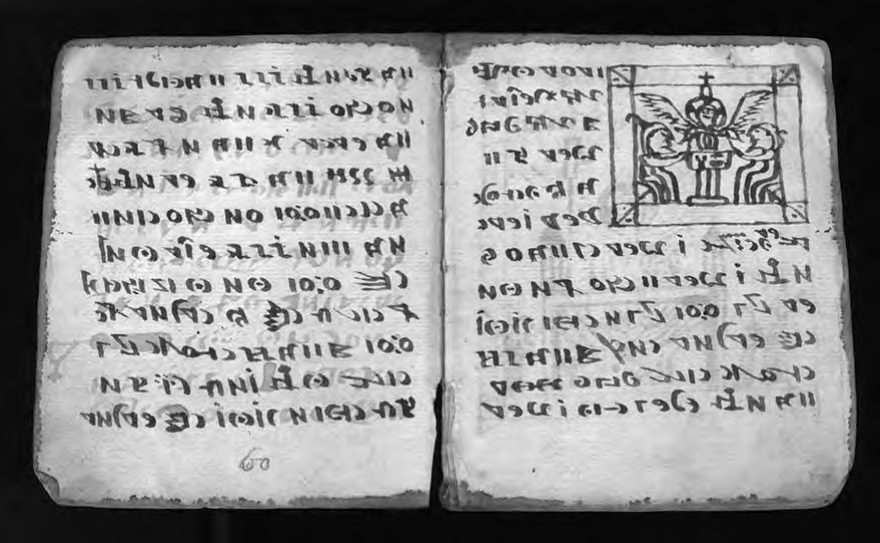
Eighty-seven illustrations are set into the text. They show crucifixions, resurrections and biblical narrative, alongside scenes of warriors in combat and a religious symbolism that does not belong to one tradition. They are crude. They are also the single most informative thing in the manuscript, and both people who cracked any part of this got in through them or alongside them.
I. What They Show
The bulk of the imagery is Christian and narrative: the crucifixion, the resurrection, scenes that follow the Gospels. Some are military, with warriors in combat. That mixture on its own would be unremarkable for the period.
What is remarkable is the symbolism. Crosses, crescents and sun motifs appear together in the same book. For Renaissance Europe that is unusual enough to demand an explanation, and the two available explanations are very different. Either the maker worked in a place where Christian, Muslim and older traditions were in genuine contact, which in sixteenth-century Hungary, on the frontier of Ottoman expansion, is entirely possible. Or the maker was not working from a single settled iconography at all, and was assembling from whatever was to hand.
The drawings are unquestionably crude by the standard of professional manuscript work. That has been used as evidence of forgery for a century and a half. It works at least as well in the other direction, and the forgery page makes that case: a fake built to impress a buyer would have been built to impress.
II. What Has Been Recognised In Them
Delia Huegel, working from Arad in western Romania, spent several years on the religious dimension of the drawings. Her work is on the pictures rather than the script, and it has produced identifications that nobody else had made.
- A hellmouth compared to Dürer's. She set the codex's hellmouth against Albrecht Dürer's, and the resemblance points to north-western European religious iconography as a specific influence on whoever made this book. That is a real constraint on its origin, arrived at without reading anything.
- King David at prayer, identified in one of the scenes.
- The name of God in Hebrew, written back to front. She identified a rendering of YHWH reversed.
A back-to-front YHWH tells you two things at once. Whoever made this book had enough contact with Hebrew to reproduce the name of God, and not enough to get it the right way round. That is a very particular kind of person: literate, religiously serious, working at second hand from a tradition they knew of but did not command. It also sits oddly well beside a text that runs right to left. Neither observation is a decipherment. Both narrow the field of who could have made this.
The pictures were also Gábor Tokai's way in. He is an art historian, and he began by dating the imagery. Working outward from the drawings into the text immediately around them, he found the INRI inscriptions coded on the drawn crosses, and then the codes standing for the evangelists, and then four-digit numbers behaving like years. The pictures told him what the adjacent text ought to say, and that is as close to a bilingual as this manuscript has ever offered anyone.
III. Why the Pictures Settled the Genre
Long before anyone could read a sentence, the illustrations had already answered the largest question about the book: what kind of thing is it. A manuscript filled with crucifixions, resurrections and Gospel scenes is a religious book. That conclusion needs no cryptography and it has never been seriously disputed.
It is also what killed Enăchiuc's reading as firmly as her transliteration did. A translation that renders the text as a chronicle of eleventh-century Vlach military campaigns has to explain why the book it appears in is full of Christian devotional art. It has no answer.
Király and Tokai's conclusion, that the codex is an ordinary Catholic reader of its period, is the conclusion the pictures had been pointing at the whole time. The achievement was not guessing the genre. It was demonstrating it from the writing.