The Rohonc Codex 448 pages in a script nobody has read, on Venetian paper of the 1530s. Two centuries of attention, four proposed readings that disagree even about which direction the text runs, and one result the field takes seriously. Not a decipherment.
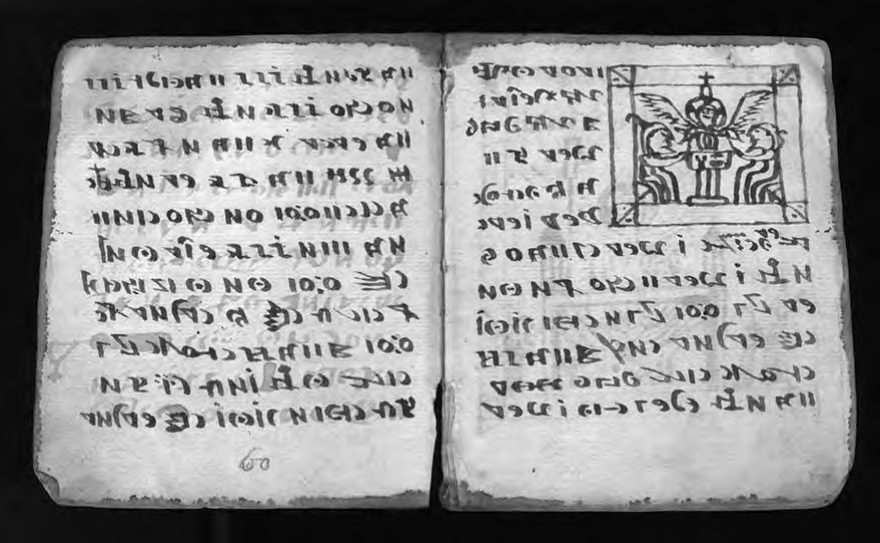
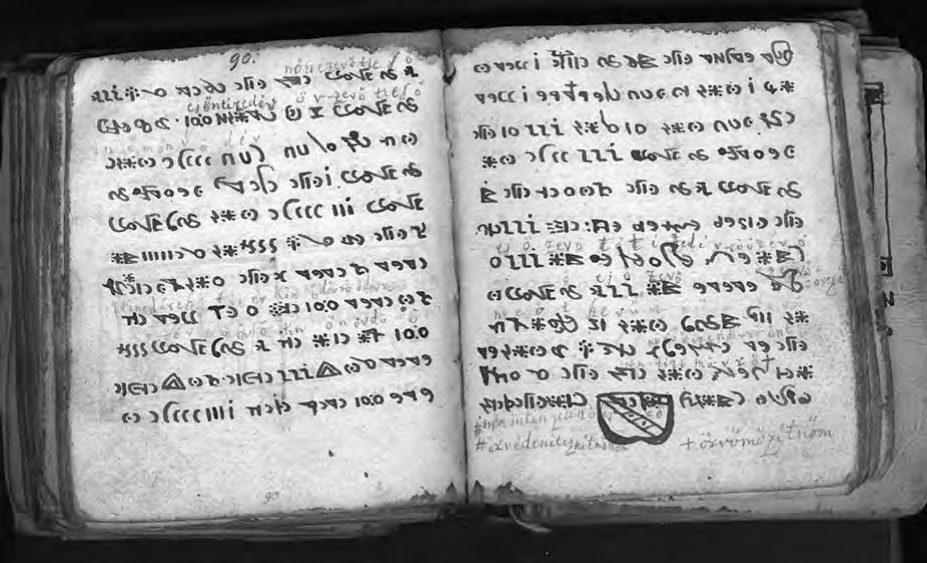
A small book, about the size of a paperback, holding 448 pages of dense writing in a script that matches no known writing system, illustrated with 87 drawings of religious, secular and military scenes. It appeared in 1838 in a donated library and has no documented history before that date. Its paper is Venetian, watermarked to the 1530s.
Since then it has been examined by the founding figure of Hungarian literary history, an Innsbruck orientalist, two professors in Prague, and a celebrated painter who carried it to Paris at the height of his fame. None of them got anywhere. It has been declared a forgery, a Dacian war chronicle, a Hindi gospel, a Sumerian prayer, and an ordinary Catholic prayer book. Those cannot all be true, and three of them collapsed the moment anyone checked the method rather than the conclusion.
These pages set out what the object is, what happened to it, what has been claimed and on what evidence, and why almost none of it can currently be tested by anyone outside two people. That last point is the reason this site carries no finding of its own.
- Object
- MS K 114
- Held
- Library of the Hungarian Academy of Sciences
- Pages
- 448 · approx. 12 × 10 cm
- Paper
- Venetian watermark, 1529–1540
- Illustrations
- 87
- Signs
- Disputed · up to 792 counted
- Direction
- Right to left, top to bottom
- Provenance
- Donated 1838, Count Gusztáv Batthyány
- Status
- Undeciphered · no claim made here
- It presents no reading of the codex and no result of ours. We have not assigned a sound or a meaning to a single sign.
- The one published reading the field takes seriously is Tokai and Király's, and it is theirs. It is described in their terms, with the objections to it.
- Our only original contribution is a measurement of the public page images, and it is negative: they are not sufficient to build a transcription that could be trusted.
- No decipherment is claimed here, for anybody's work including ours.
I. The Object
The book is small and dense. Each page carries between nine and fourteen rows of symbols. The paper is the one part of it that can be dated with confidence: every leaf bears a watermark of an anchor inside a circle inside a six-rayed star, a Venetian design in use between 1529 and 1540.
That dates the paper and not the text, and the distinction matters more here than it usually does. A scribe can write on old stock. A copyist can put a much older exemplar onto new paper. And a forger can buy genuine sixteenth-century paper precisely because it makes an object look older than it is. The watermark sets a floor and nothing else. On the evidence of the drawings, most estimates put the writing in the sixteenth or seventeenth century, and Tokai and Király read a date inside the text itself that points to 1593.
The name comes from Rohonc, in western Hungary, now Rechnitz just over the Austrian border. In 1838 Count Gusztáv Batthyány gave his family library to the Hungarian Academy of Sciences and the codex was in it. Before that there is nothing certain. A 1743 catalogue of the Batthyány holdings lists Magyar imádságok, volumen I in 12, Hungarian prayers in one duodecimo volume, which is the right size and the right sort of description. It is an inference and not a chain of custody, and the gap it fails to close is ninety-five years wide.
It is still in that library, as manuscript K 114. Consulting the original requires permission. There is a microfilm, there are digital scans of varying quality, and eight pages were rephotographed at higher resolution by the University of Hamburg in 2015. Eight, out of 448.
II. Why It Is Hard
Undeciphered scripts fall into three groups, and the group decides the difficulty.
If you know the language but not the script, you are in the best position anyone has ever been in. That was Linear B: Michael Ventris eventually established that the language underneath was Greek, and once you can guess at the words the signs fall out.
If you know the script but not the language, you can at least read the sounds aloud and look for something familiar. Etruscan sits here, written in a perfectly legible alphabet, saying things nobody can follow.
The Rohonc Codex is in the third group, where neither is known. So is the Indus script. So is the Voynich Manuscript. Every constraint has to be manufactured from the text's own internal behaviour, because nothing outside it is fixed.
And this manuscript adds two difficulties of its own. The sign inventory is very large, somewhere between the low hundreds and 792 depending on who is counting, which rules out the frequency attacks that break ordinary ciphers. And there is no bilingual: no Rosetta Stone, no parallel text, no passage whose content is known independently. What Tokai and Király found instead was the nearest available substitute, which was numbers.
Four further pages set out the rest: what happened to the codex over two centuries, the four readings and what became of them, the forger it was blamed on, the 87 drawings and what has been recognised in them, what is known about the writing itself, and why almost none of it can be tested.